
Fragrance FAQs
What exactly is a perfume?
Let's take this in two parts. First we'll talk about what goes into a perfume. And then we'll see what effect it has on us.
What women put on is called a perfume, while men put on fragrances. What's the difference? Well, perfumes are mixtures of many chemicals (called notes), while fragrances are much simpler.
The chemicals used in a perfume or fragrance are called essential oils (better known as essence). All of these can evaporate very quickly when left open, and are generally gotten from the leaves or flowers of plants. For example, limonene is an essential oil that comes from lemon leaves and gives the familiar 'lemon' smell.
Essential oils for making perfumes are extremely expensive, and were among the things for which traders would go any length. They form a big part of Sinbad the Sailor's adventures. Of the three gifts the Magi gave the infant Christ, two were essential oils - myrrh and frankincense.
So how is a perfume made?
Most perfumes are made by mixing three kinds of essential oils. Scents that fade quickly are called top notes. They are light scents that fade quickly and give the first impression, like bergamot and citronella. Middle notes last for a few hours and provide the dominant scent of the perfume. Like rose, juniper or marjoram. Finally come the base notes, made of exotic material like anise, myrrh and frankincense. The last is a thick, gum like material extracted from Boswellia trees that grow in Yemen. The dried gum when powdered and mixed with charcoal is often used in incense and dhoop sticks.
Today, we know the chemical nature of these essential oils, and therefore they can be made in a chemical factory. When you mix up different oils, you can make a perfume that resembles the natural one. For example, a mixture that has geraniol, citronellol, phenylethyl alcohol and linalool in a ratio of 30:25:25:5 will smell just like roses!
Right. So what makes a perfume so great?
That's got to do with our sense of smell. This is the sense that makes us aware of the chemicals in our environment, and the brain marks them as good or bad smells. Chemicals that are bad for us (like ammonia or hydrogen sulphide) smell bad, so we avoid them. Chemicals that are good for us (like the natural chemicals of food) smell nice. That's why we walk away from a gutter and walk towards a nice smelling cup of coffee!
Our brains treat the smells from flowers and fruits as attractive, because it often implies that there is good food to be found with them. The brains of bees and butterflies think like that too, which is why they love being near flowers.
Long ago, someone (perhaps a lady) figured out that if you rubbed these leaves and flowers on yourself, other people would be attracted to you too. Later on, Arab chemists like Jabir ibn Hayyan and al-Kindi found that you could extract the essential oils from these flowers and leaves using alcohol or ether. And that started the perfume industry!
What is an essential oil?
An essential oil is a concentrated, volatile, aromatic liquid that is obtained from the fruits, seeds, flowers, bark, stems, roots, leaves or other parts of a plant. There are estimated to be 10,000 aromatic plants (ie that contain essential oils) on Earth, and about 500 of these are processed commercially for essential oil extraction. These oils have been used for centuries for both their healing and aromatic benefits. This is most commonly accomplished by steam distillation (steam is passed through the plant material), and sometimes hydrodistillation (the plant is gently boiled in water). More modern methods include mechanically expressing oils from citrus fruit peel, and solvent extraction. Solvent extracted oils include CO2 extracts and absolutes, and these are not classed as essential oils.
What is a perfume wheel?
Since its creation, the wheel and the developed fragrance classification scheme has been modified several times through the addition of different groups to encompass different fragrance types.
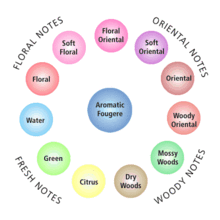
The four standard families are Floral, Oriental, Woody and Fresh. These are in turn divided into three sub-groups (e.g. in the Floral Family: Floral, Soft Floral, Floral Oriental) and arranged in a circle, each group being related to the next. Each of the subclasses were in turn divided into Fresh, Crisp, Classical, and Rich compositions. Prior to 2010 Fougère family was placed at the center of this wheel since they are a large family of scents that usually contain fragrance elements from each of the other four families; citrus from the fresh family, oak moss and woods from the woody family, coumarin and incense from the Oriental family, and lavender from the floral family.[5]
In this classification scheme, Chanel No.5, which is traditionally classified as a "Floral Aldehyde" would be located under Soft Floral sub-group, and "Amber" scents would be placed within the Oriental group. As a class, Chypres are more difficult to place since they would be located under parts of the Oriental and Woody families. For instance, Guerlain Mitsouko, which is classically identified as a chypre will be placed under Mossy Woods, but Hermès Rouge, a chypre with more floral character, would be placed under Floral Oriental.